

- System failure in Afghanistan
- Biden to address the nation at 3:45 p.m.
- Taliban declare victory in Afghanistan
- U.S. temporarily suspends evacuations at Kabul airport to clear runway
- Scoop: Joint Chiefs chairman moves up terrorist threat in Afghanistan
- Thousands of prisoners freed by Taliban could pose threat to U.S.
- Reports of several dead amid chaos at Kabul airport
- Jake Sullivan: Biden didn't think it was "inevitable" Taliban would take control
I am the FIRST!!!
regular 4 post ff

infinite scroll 4 pff
Aug. 17, 2021 12:57PM EST
How sports retailer Fanatics achieved "decacorn" status
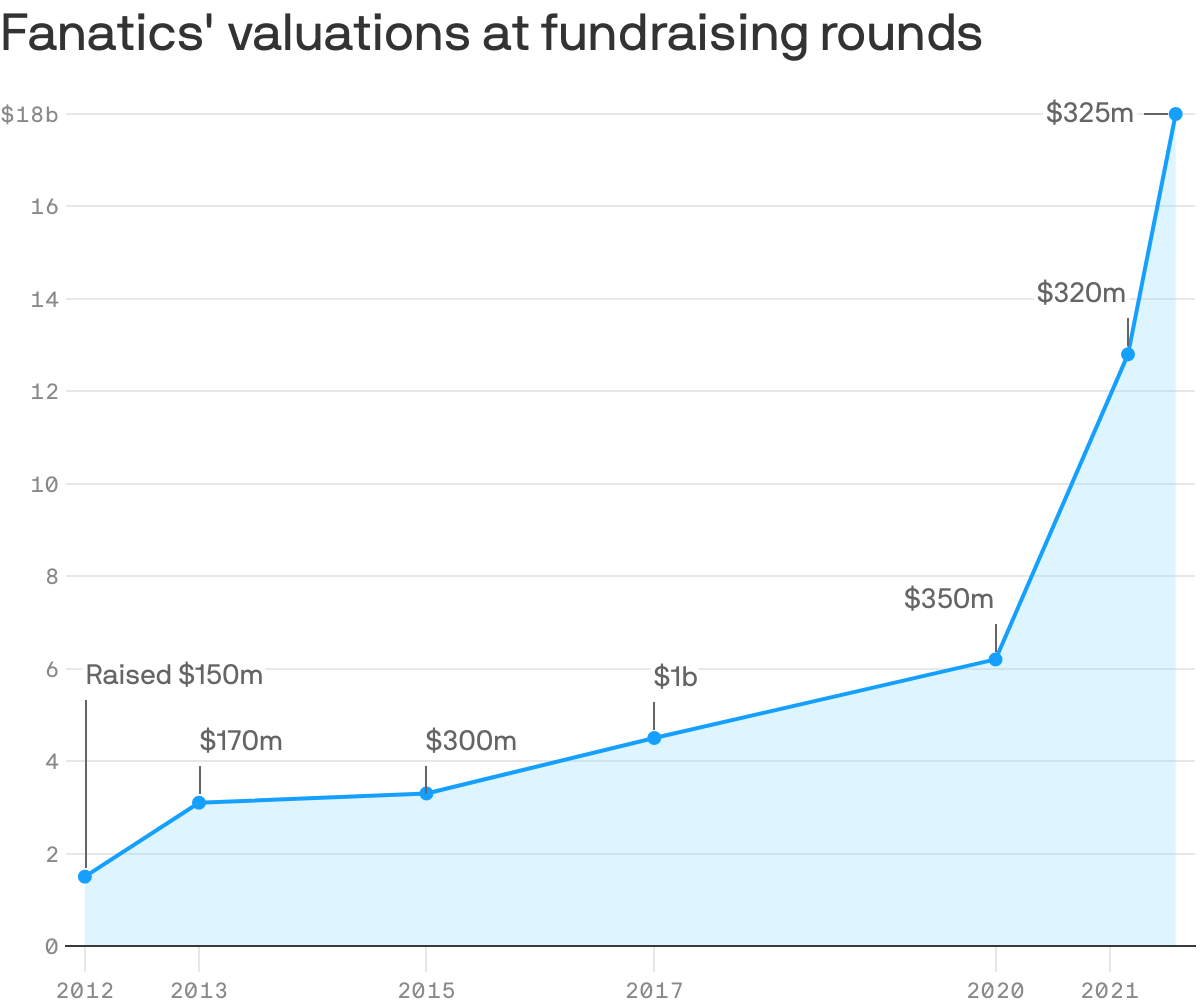
Data: CrunchBase; Chart: Connor Rothschild/Axios
Fanatics has nearly tripled in value over the last year. Now, the e-commerce giant wants to expand into new businesses like sports betting, ticketing and media.
Driving the news: Fanatics closed a $325 million funding round last week that values the company at $18 billion, making it the world's 12th-most valuable private company, per CB Insights.
The top 12 include:
- Bytedance ($140B)
- Stripe ($95B)
- SpaceX ($74B)
- Klarna ($45.6B)
- Instacart ($39B)
- Revolut ($33B)
- Nubank ($30B)
- Epic Games ($28.7B)
- Databricks ($28B)
- Rivian ($27.6B)
- FTX ($18B)
- Fanatics ($18B)
How it works: Founded in 1995, Fanatics achieved "decacorn" status ($10+ billion valuation) by controlling the sports apparel supply chain. Jersey sales go through them, period. And they don't just sell clothes — they make them, too.
- As the official retailer of licensed merchandise for many U.S. sports leagues and universities, Fanatics generates ~80% of its revenue from sales on Fanatics.com and the 300+ team and league sites it operates, per WSJ (subscription).
- Now, it will expand far beyond that, creating new products to further monetize its database of 83 million sports fans. After all, the people buying jerseys are the same people buying tickets and placing bets.
- In June, Fanatics formed an NFT company called Candy Digital and hired former FanDuel CEO Matt King to run its betting operations. Now, it's launching Fanatics Sportsbook.
The bottom line: Fanatics will eventually go public. Until then, there appears to be one goal as a private company: Try to take over the world.
Keep reading... Show less
Jul. 22, 2021 09:37PM EST
Czech cyclist Michal Schlegel tests positive for COVID-19 one day ahead of Olympic opening ceremony
Czech road cyclist Michal Schlegel has tested positive for COVID-19 and will no longer be able to participate in Saturday's road race, the Czech Olympic Committee announced in a statement Thursday.
What they're saying: Schlegel is "[t]he fourth athlete and the sixth Czech member of the team, who did not avoid a positive test for COVID-19 at the Tokyo Olympics..."
- The news comes just one day ahead of the Olympic opening ceremony, which health experts fear could become a superspreader event.
The big picture: Schlegel is currently in isolation at the hotel for cyclists in Tokyo.
- Czech beach volleyball player Ondřej Perušič, table tennis player Pavel Širuček and beach volleyball player Markéta Nausch have also tested positive for COVID-10.
- The Czech Olympic Committee has launched an investigation into the potential spread of the virus aboard the charter flight to Tokyo last week, the statement notes.
- "Prime Minister Andrej Babiš has described the situation as a scandal and unfair to the athletes," per Radio Prague International.
Keep reading... Show less
May. 30, 2021 11:00AM EST
The Southwest's climate warning: Drought, wildfire risk and rising temperatures
One of the fastest-warming regions of the U.S. is the Southwest — and that region, plus the broader West, is stuck in its most expansive and intense drought of the 21st century.
Why it matters: Studies show that a warming climate is exacerbating the drought, and in some ways may be triggering it in the first place. That means the Southwest is drying out — and California's large wildfires could start as soon as next month.
- And one climate researcher says California's Sierra Nevada Mountains saw one of the fastest snow melt-outs in history this year.
- The drought situation is particularly severe in the Colorado River Basin and northern California. Scientists and public officials are warning that the California wildfire season is likely to be severe, due to the combination of dry vegetation and above-average temperatures.
- This one comes on the heels of the worst fire season in state history, which turned the skies above San Francisco a "Blade Runner" orange last year.
The big picture: Some parts of the world are already getting close to, or have slipped beyond, the Paris agreement'stemperature limit thatscientists warned about in a report last week.
- As Earth's temperatures tick upwards, closer to the Paris guardrail of 1.5°C (2.7°F) above preindustrial levels, some parts of the world are already warming by much greater amounts, from the Southwestern U.S. to the Arctic. These areas are seeing destructive impacts that are mounting.
Details: California's Sierra Nevada Mountains show what climate change can do as it worsens. The mountain snowpack, which provides 30% of the state's water supply annually, has vanished about two months ahead of schedule.
- Water runoff from snow melt has been paltry, and major reservoirs like Lake Oroville are running even lower than they did during the record drought from 2012-2016.
- Climate change is playing a key role in the drought, by boosting temperatures and increasing the loss of water to the atmosphere. Much of the snow went directly from frozen form back into the air, rather than melting into runoff.
- Warming is also thought to be leading to increasing chances of dry fall seasons in the Golden State and shortened rainy seasons, according to Daniel Swain, a climate researcher at UCLA and the Nature Conservancy.
Craig Clements, who studies wildfires at San Jose State University, warns that large wildfires typically not seen until late summer in California could occur this year as early as June. Vegetation is at near record dry levels for this time of year, he said.
- "We are starting off in a more dire situation than we typically would for June," Clements told Axios.
Context: The worsening drought and potentially devastating wildfire season is not an isolated occurrence for California and other Southwestern states.
- Climate studies have consistently shown that as the world continues to warm, the Southwest will become drier and hotter. This is worrisome, given the likelihood of increased stress on water resources amid a population boom in states such as Arizona and Nevada.
- Although it's interspersed with short intervals of wetter years, parts of the West, including California, are suffering through an emerging, human-caused "megadrought" that began in 2000.
- Studies show this drought, measured using soil moisture data and tree rings, is the second-worst in the past 1,200 years.
What they're saying: "This current drought has quickly accelerated, and is now on par (if not worse) than the extreme and in some cases record-breaking drought that occurred just 5 years ago in California," Swain said.
What's next: If the world does not steeply reduce greenhouse gas emissions starting in this decade, more areas will warm to near or above the Paris limits, until the global average arrives at that level as well.
- This threatens to unleash catastrophic impacts, such as the melting of parts of the Antarctic Ice Sheet.
- For now, the drought and likely severe wildfire season in the West offer an unfortunate preview of what may come next.
Go deeper:
Earth may temporarily hit Paris climate limit in next 5 years
Keep reading... Show less
Mar. 27, 2021 02:28PM EST
Building the AI-enabled factory to perfect manufacturing
A startup is employing AI to streamline and perfect manufacturing.
Why it matters: As valuable as machine learning has been in software, the next phase could be even more disruptive: bringing AI to the often messy process of making things.
What's happening: Nanotronics, a Brooklyn-based science technology company, has developed a platform that combines AI, automation and computer imaging to identify anomalies in the manufacturing process.
- Quality control is usually the province of workers, but Nanotronics is able to automate much of the process, leading to an "autonomous factory that can change parameters and create alerts, doing things that humans just wouldn't be able to do," says Matthew Putman, the company's founder and CEO.
- For Nanotronics' partners — which include biotech and semiconductor companies — "AI becomes a great partner in being able to build a factory," he says.
By the numbers: A report published last year from the research firm Technavio estimates that the size of the broader automated industrial quality control market is expected to grow by 7% a year between 2020 and 2024.
- That growth will likely be accelerated by the effects of the pandemic, which disrupted supply chains and put a premium on the ability to automate manufacturing as much as possible.
Situational awareness: On Thursday, Nanotronics announced a partnership with chemical manufacturer Solugen to use its technology to ensure clean water and safety in Solugen's autonomous chemical plants.
"I don't want the next big tech idea to be a social network. I want it to be a factory."
Matthew Putman, Nanotronics
Go deeper: AI is industrializing
Keep reading... Show less

